

- The Power Pit
- The quiet giant wants to get loud: HWA EVO.R
The quiet giant wants to get loud: HWA EVO.R
When the road-legal HWA EVO was first pushed hard around the Green Hell as part of its test program, something happened that no spec sheet can capture: the people who built this car saw it drive. And they didn’t want to give it back. The HWA EVO.R was born, long before it had a name.
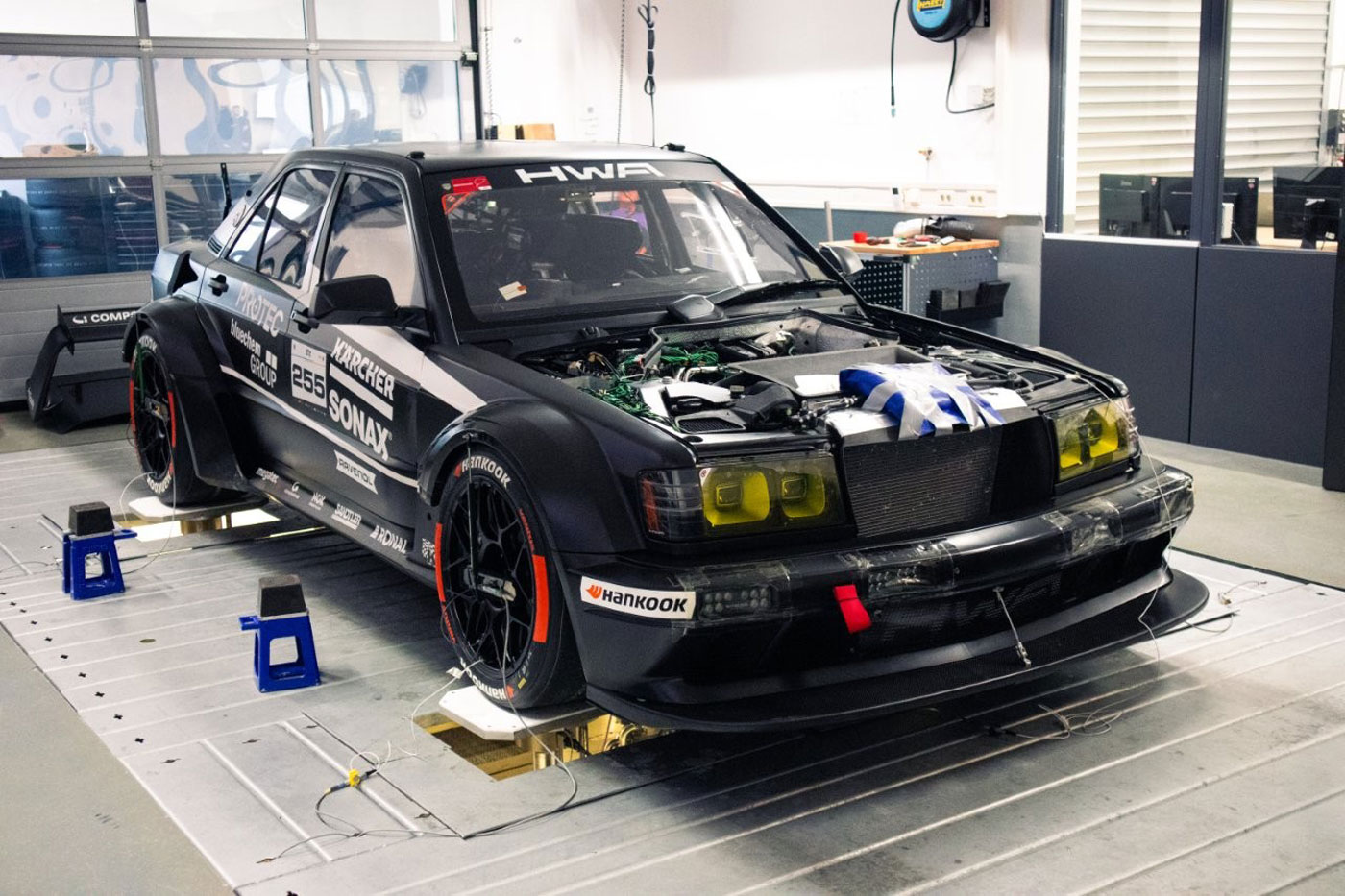
To understand this step, you need to know who HWA is. Founded in 1998 by Hans Werner Aufrecht—one of the two names behind AMG—the Affalterbach-based company spent nearly three decades helping others win: eleven drivers’ titles, more than 180 DTM victories since 1988. The race cars that brought Mercedes home were built and run here. Only one thing: the car never said HWA. The most talented teammate no one knew.
That changed with the HWA EVO.
Not a restomod, but a clean-sheet design that preserves the Mercedes-Benz 190E 2.5-16 Evo II’s shape and soul—while starting from zero technically: new chassis, carbon, aluminum, uncompromisingly focused on performance. And then the next, perfectly logical thought: if we’re building our own car anyway, why not go racing with it too?
“The step from the EVO to the race version was a natural decision, but also a technical challenge,” says HWA CTO Gordian von Schöning. A sentence backed by months of hard work—and the matter-of-fact certainty of an idea that’s simply right.
For CEO Martin Marx, it wasn’t a calculation but a feeling: after more than 25 years at the top of motorsport, the Nürburgring Nordschleife had long been “like a second home” for HWA. Finally competing there with their own car wasn’t a marketing move—it was unfinished business with their own history.
A legend on the way to becoming a legend
Anyone who thinks the path from the EVO to the EVO.R is just a matter of a sport exhaust and stickers hasn’t understood HWA. Nothing was sharpened cosmetically here—it was rethought from the ground up: widened wheel arches, a revised front hood with NACA ducts, polycarbonate instead of glass, removable front doors for lightning-fast driver changes.
All weekend long everyone was in this project heart and soul.
— Martin Marx, CEO, HWA AG
Specially developed, weight-optimized RONAL racing wheels make sure the grams disappear where they hurt most. Under the hood: an in-house 3.0-liter V6 biturbo with around 560 hp and 670 Nm, managed by a Bosch Motorsport ECU, paired with a sequential six-speed gearbox. A six-way adjustable KW and H&R race suspension and AP Racing brakes inspire confidence—deliberately balanced so ambitious amateurs can tap into the potential, too. Reinforced monocoque, FIA-homologated cage, safety fuel cell: the EVO.R is deadly serious.
Nothing was left to chance technically, either: the base may be the EVO, von Schöning says, but every component was consistently tailored to the demands of the racetrack. From the very first test runs, it was immediately clear the car delivered exactly what they had envisioned.
No one knows what it feels like at the wheel better than Luca Ludwig, who is following in the footsteps of his father, Klaus Ludwig, with the EVO.R. Compared with a GT3, he said after one of the first race outings, the EVO.R moves around noticeably more. If you really want to be fast in it, you need “balls.” Not understatement—genuine respect for a car with character: even in fast sections, enormous potential was already tangible, and the team learned a huge amount that day.
Just as important to Ludwig was the courage behind the project: the increased attention, on site and online, was obvious to him. Given the work involved, he found it remarkably bold that HWA took this step at all—along with the necessary investment. Before the race, he stayed grounded rather than boastful: he realistically expected mid-pack, but with a clean run he hoped for a top-30 finish and a class podium.
The night that confirmed everything
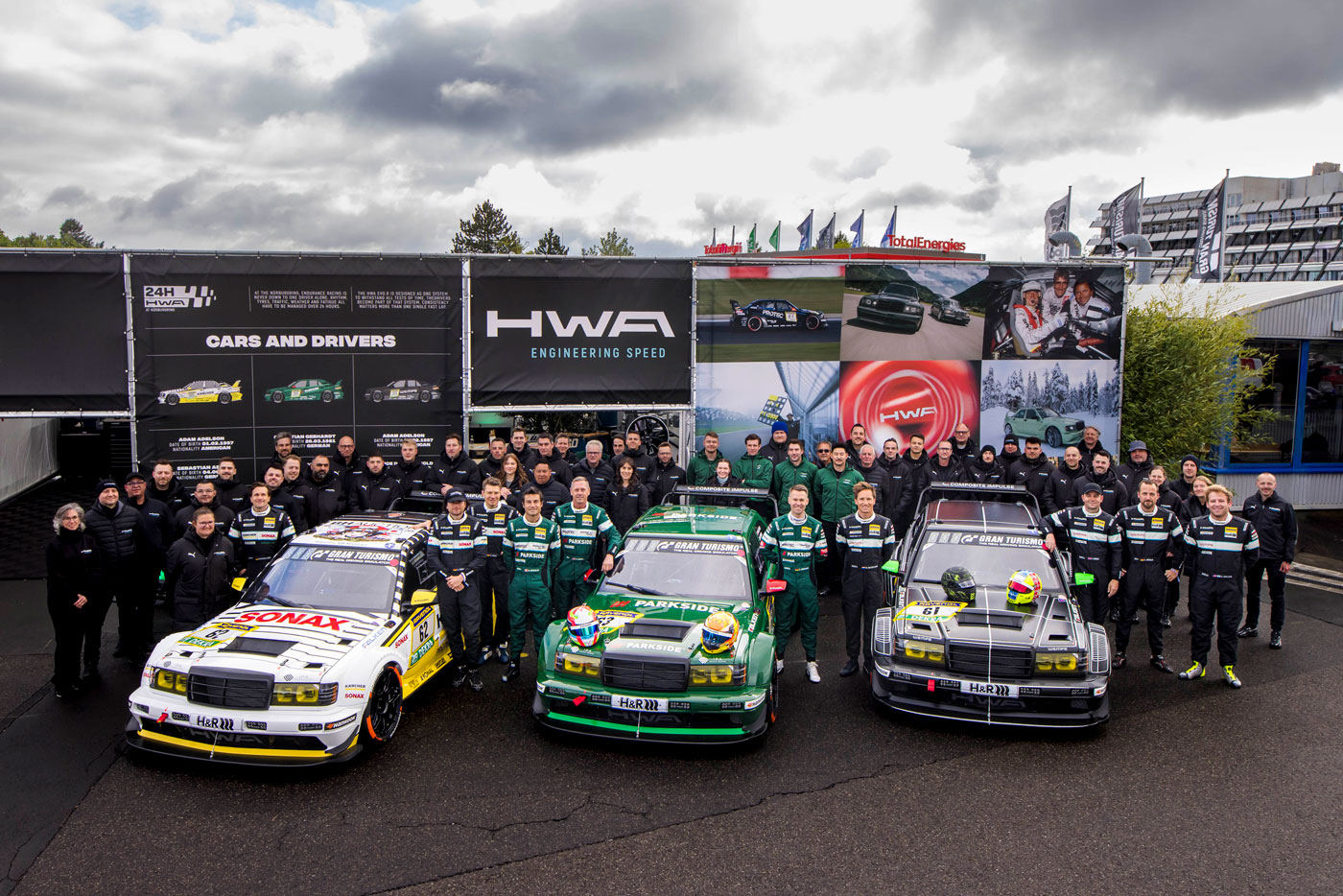
Originally, two cars were meant to be enough. But interest was so strong that a third vehicle was added. In the HWA EVO.R with start number 62, three men with famous DTM surnames shared a cockpit: Sebastian Asch, Luca Ludwig, and Markus Winkelhock—alongside regular driver Adam Adelson. Asch and Ludwig are the sons of Mercedes touring-car legends Roland Asch and Klaus Ludwig, who once fought each other for DTM titles in the 190E Evo II—and who were already involved in developing the road-going EVO before their sons were even allowed behind the wheel. Not a coincidence, but a bow to their own past: yesterday’s rivalry, now teamwork in the same cockpit.
Extra goosebumps came courtesy of HWA EVO.R #63: Bruno Spengler was at the wheel, who raced for HWA in the DTM from 2005 to 2011 and became one of the series’ most successful drivers. When Martin Marx called him personally, he didn’t have to think twice: “It feels great to be driving for HWA again,” he said, visibly moved, about his reunion with the “Green Hell” and many familiar faces from his DTM days.
König Pilsener, Kärcher, and SONAX as partners—logos that were already stuck on Mercedes DTM cars in the early ’90s. It wasn’t just three new cars running here; an entire story was along for the ride.
In front of 352,000 spectators, in changeable weather and with numerous incidents, the trial by fire followed.
In the middle of the night, after around nine hours, Sebastian Asch delivered one of those live moments that make a 24-hour race: a risky tire call in shifting conditions,
a spontaneous switch to slicks, then a cooling-system leak that briefly put the pit box on edge. “The car has worked relatively well so far,” he reported matter-of-factly between the dramas—and in the end, he was right.
Twenty-four hours later, all three HWA EVO.R cars cross the finish line. The #61 with Adam Adelson, Lance David Arnold, Jamie Green, and Renger van der Zande secured second place in the SP-X class. The DTM-sons trio in #62 fought back to third despite a radiator issue. Bruno Spengler brought the #63 home in fourth, together with Christian Gebhardt, Evald Holstad, and Peter Ludwig. Not a perfect race, but an honest one—and a debut you couldn’t have scripted better in Affalterbach.
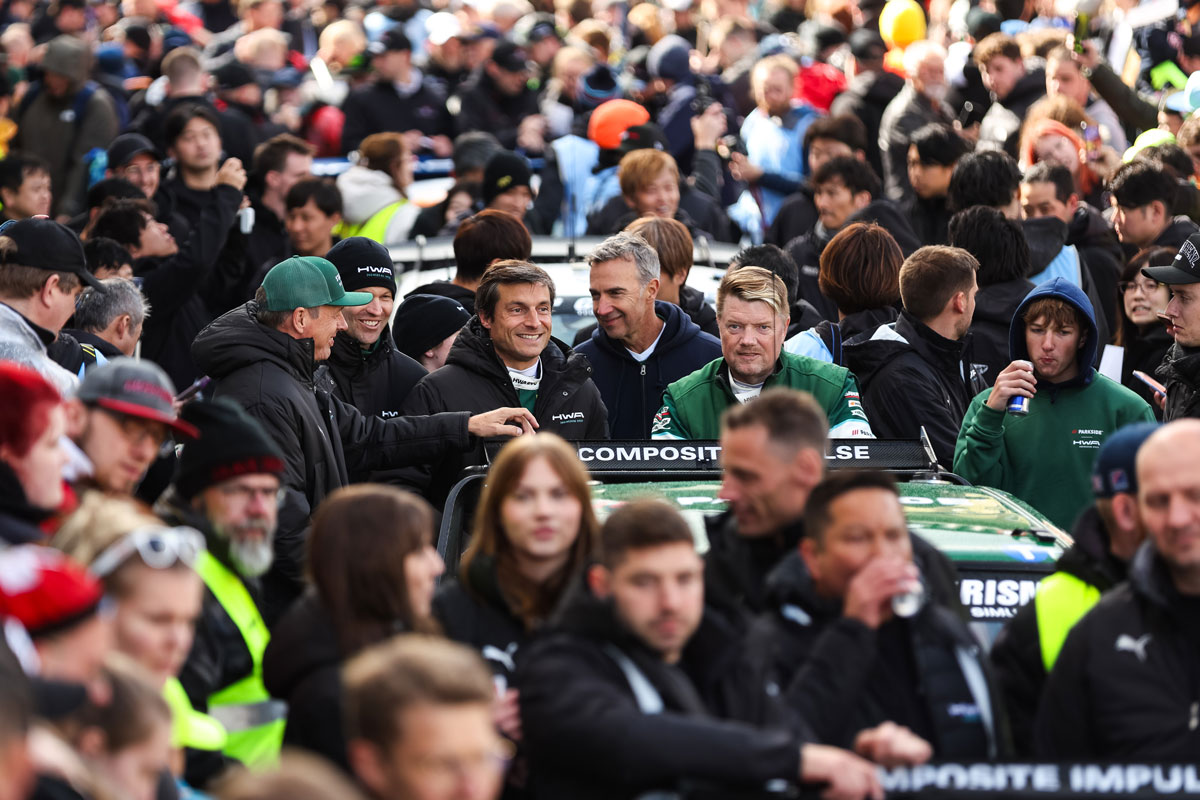
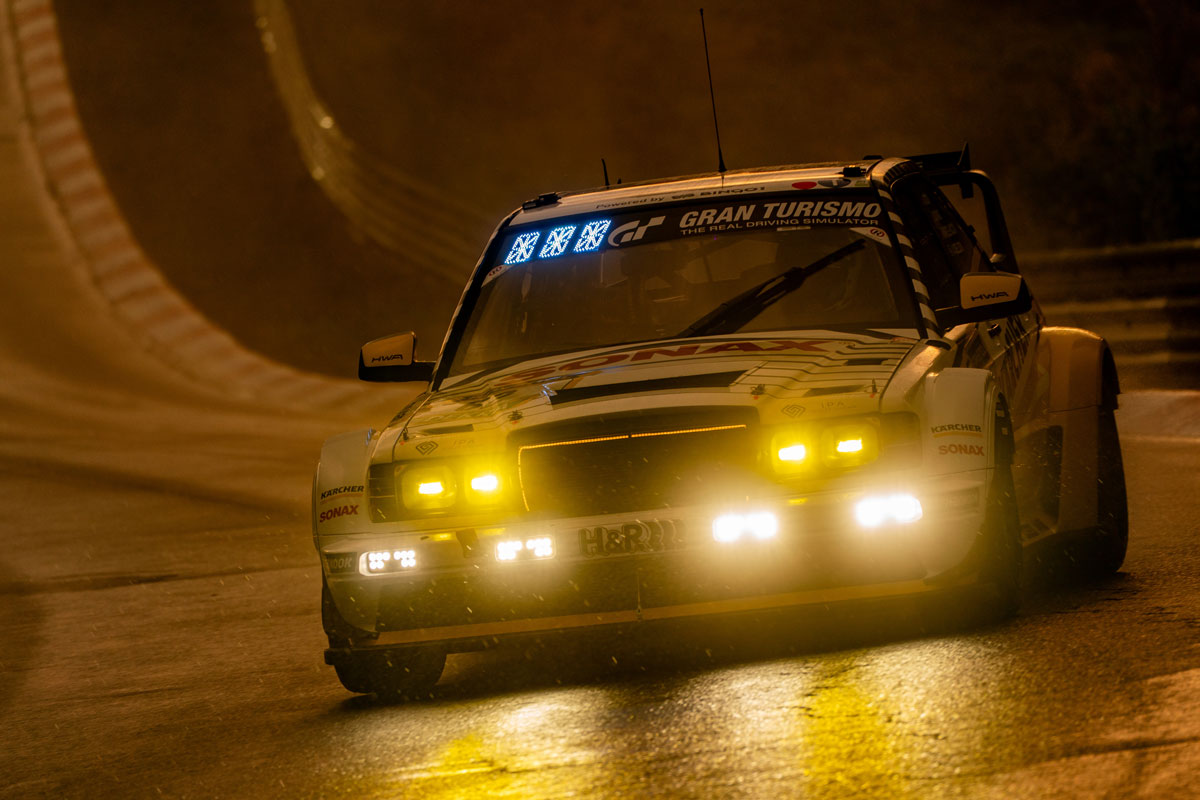
Afterwards, Martin Marx could barely put what he’d experienced into words, visibly still caught up in the moment: his core message was that he was incredibly proud of every individual’s contribution to the team, and impressed by how emotional everyone was together in the end. All weekend, they’d been invested in this project “heart and soul.”
Gordian von Schöning didn’t need many words for the mood in the pit box either: it had been emotional and exhausting, but above all one thing in the end—pure joy. Three cars entered, all three finished: a result he called “unparalleled and unforgettable.”
And now? The start of something bigger
Anyone who thinks the story ends with the checkered flag doesn’t know HWA. During the race weekend, the company announced its next statement: a customer motorsport version of the HWA EVO.R limited to 15 units, technically derived directly from the Nürburgring racer, configurable with packages such as an “endurance package” or an Electronic Kit—plus a support program with in-house technicians and spare-parts service. Not a niche product for a display case, but a tool for anyone who wants to experience for themselves what HWA spent three decades working on behind the scenes.
The HWA EVO.R is more than a new chapter. It’s proof that a company that helped others win for decades is allowed to win for itself at some point—and that the best motorsport story is sometimes the one you write yourself.
Jürgen Preuss, infact.digital
Copyright: © HWA AG
Nationales Automuseum
SONDERAUSSTELLUNG
„Rallye-Legenden – Zeitreise auf Asphalt, Schotter und Schnee“ Noch bis 2027 im Nationalen Automuseum. Nicht verpassen!