
- The Power Pit
- LEGENDS OF LE MANS LOTUS EVORA GTE
LEGENDS OF LE MANS LOTUS EVORA GTE
You’ve been involved in motorsport for a long time—your enthusiasm makes that immediately obvious. What originally motivated you to start racing? Was there a big dream early on—maybe even Le Mans?
Professor Wolfgang Henseler: I’ve been a motorsport enthusiast since childhood. But it took a very long time to get from the Carrera track to a real race track. Starting with karting—though I was already in my early 50s then, so there was no prospect of a Formula 1 engagement—moving to the Peugeot Spyder Cup as an entry into real motor racing in my mid-50s, then to
historic race cars, and finally to a current Lotus Emira GT4. From the age of 18, I was at the Oldtimer Grand Prix at the Nürburgring almost every summer and always dreamed of being able to race there one day. However, I had to work a bit longer until I had the financial means available. This year, participating in the Le Mans Classic and the Legends of Le Mans, the Goodwood Revival, and starts in the HGPCA series with my Lotus 18 are certainly the highlights. A dream/goal for the next step would be participating in the Monaco Historic GP.
Jürgen Preuß: You can tell how early this fascination began. Was there a specific moment that finally convinced you to actively enter racing yourself?
WH: My father was always a car enthusiast, and the first photo of me at the wheel shows me as a two-year-old standing behind the wheel of our Kadett at the time. Le Mans, Monaco, Formula 1, or the Indy 500 have fascinated me for as long as I can remember. I’ve always thought the smell of castor oil and the screaming engines of the race cars in the old paddock at the Nürburgring were just awesome.
JP: Let’s talk about your current vehicle—an exciting choice. What moved you to choose this exact car? And was it perhaps already part of your collection?
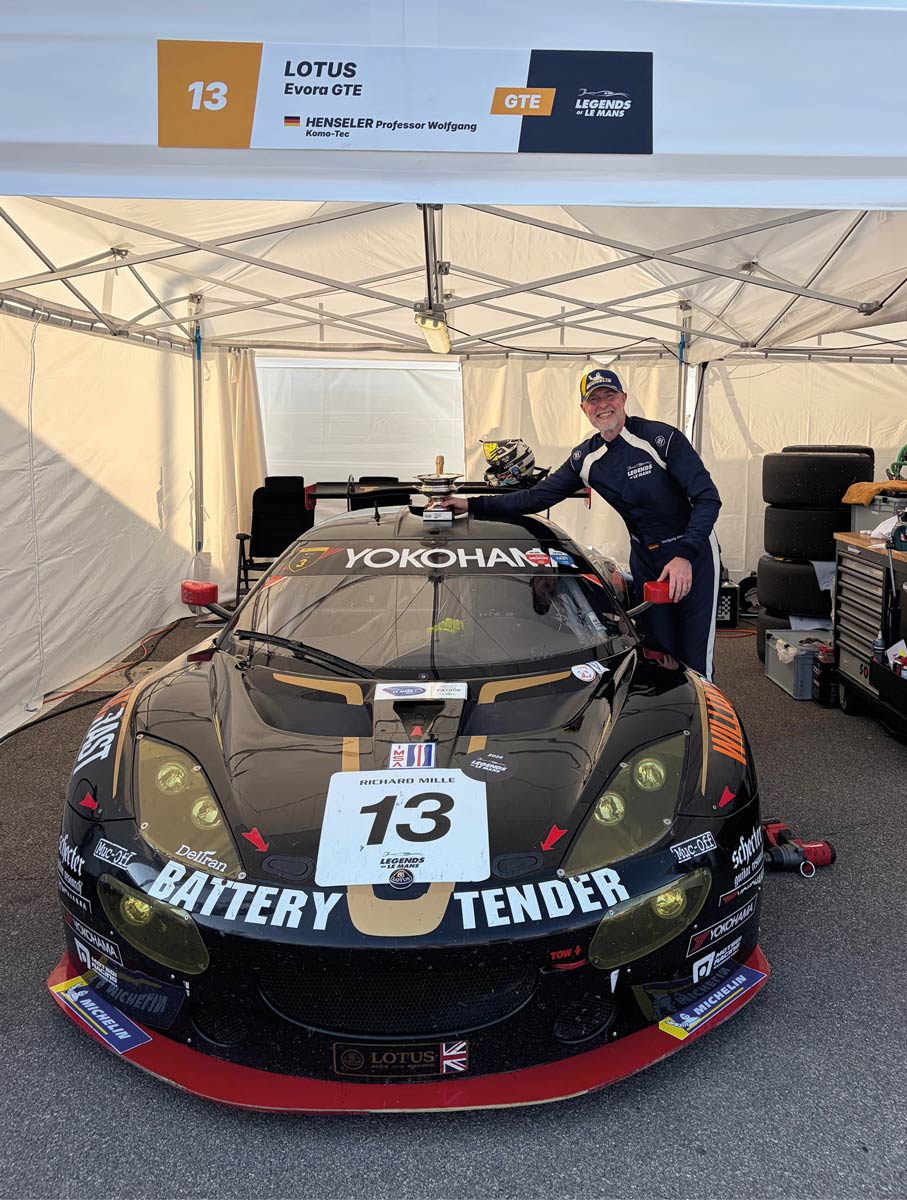
WH: I saw the Lotus Evora GTE on the internet at wirewheels.com during COVID and bought it immediately afterward. The car has a great history with the Le Mans race, participation in the Le Mans World Series in 2011, and the American Le Mans Series in 2012. As a Lotus enthusiast, the vehicle fit perfectly into my Lotus collection. By the way, there’s a great video from Lotus on YouTube about the car’s origin story—Lotus: The Road to Le Mans. Definitely worth watching, as the entire vehicle was created in ONLY four months, which is actually hard to imagine.
JP: Especially with race cars, balance is crucial: What role do performance and reliability play for you in this choice?
WH: Performance and reliability are the two key components if you want to be successful in racing. Whether it’s Formula 1, historic, or modern motorsport, the Balance of Performance and arriving safely at the end of a race are the two core factors for winning races. They don’t say “To finish first, you first have to finish” for nothing!
JP: And hand on heart—does style play a role too? After all, you want the car to look the part.
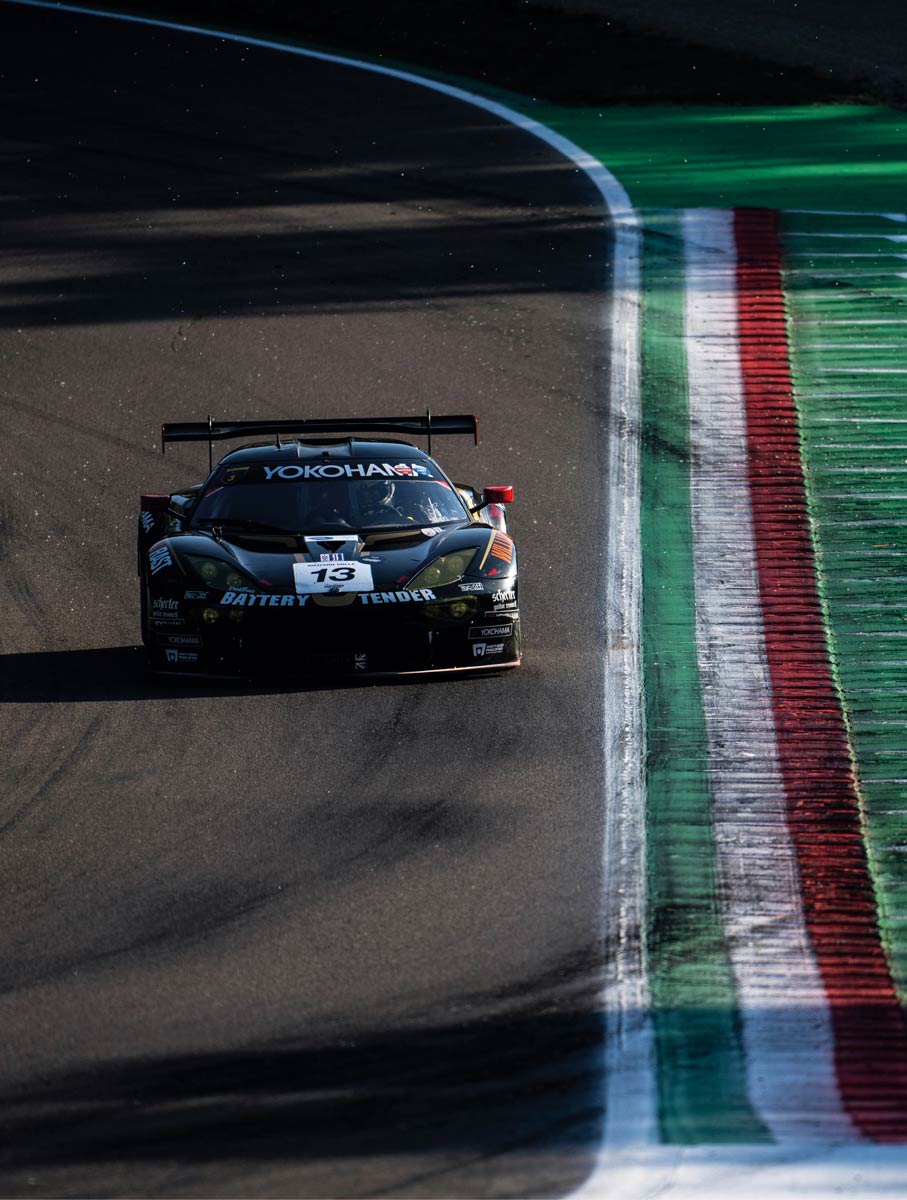
WH: Certainly. With a Lotus, appearance, performance, and weight have always played a central role. And when the Lotus comes in the most famous color scheme, “Black & Gold,” that’s quite a statement. Plus, the Lotus Evora GTE is extremely wide and aesthetically very well-balanced in its appearance. You notice at every race that the visitors, spectators, organizers, and the press love the car and its sound.
JP: Looking at racing practice—what do you see as the biggest challenges on a race weekend?
WH: Well, the Lotus is from 2011 and is therefore one of the oldest vehicles in the Legends of Le Mans racing series (Note: The LOLM series allows vehicles in the GTE class from 2011 to 2020). That’s why technology plays an especially important role—meaning, does everything hold up over the race weekend? The original electronics, in particular, are quite a challenge. There’s very little detailed info on what the developers at Cosworth programmed into the ECUs back in 2011. That means a lot of trial and error for my team to prepare the car optimally and to be able to collect and use relevant data during the race.
JP: That sounds like real teamwork. How closely are you involved in the work with the mechanics?
WH: With Komo-Tec, I have the perfect team for the car. They have an enormous amount of Lotus experience. However, even they were surprised by this specific vehicle and how much Lotus did differently in 2011 compared to, say, a Lotus Evora GT4 race car. With the Lotus Evora GTE, everything was really developed specifically for the 24 Hours of Le Mans. And every bit and byte is different there.
JP: After the tests, it’s often on to fine-tuning. What specific adjustments did you make?
WH: After the two-day test in March at Paul Ricard, there were a few small adjustments regarding the shifting behavior. Otherwise, everything was checked routinely and prepared for racing before heading to the season opener in Imola for the WEC.
JP: And if something unexpected happens during the race itself—how do you react? How big is your team, actually?
WH: (Laughs) We try to solve those unconventionally, quickly, pragmatically, and professionally, just like professional racing teams do. Our data from the car also goes to India, where developers analyze and optimize the mappings and send them back to us so we can upload them to the car again. The team on-site is very small; it’s just two people besides me. A team principal who is also the data engineer, and a chief mechanic who handles everything around the car except the data. An extremely
professional and mega-competent team.
JP: Preparation seems enormously important. How intensive is the testing phase before a race?
WH: Most testing is done at the beginning of the season to make sure everything fits and that you as a driver feel comfortable in the car. There are always a lot of little things to optimize the performance of the car and the driver. With the Lotus Evora GTE, we spent two days testing at Paul Ricard with the team and Peter Auto in March, which was incredibly important to get as much data from the car as possible and to see that everything works after the long downtime and the thorough refresh of the car. We tried many mappings, checked if the engine temperature was right, improved shifting patterns, measured
fuel consumption, changed aerodynamics, and much more.
JP: And which of these findings were particularly decisive in the end?
WH: First of all, the collected data and the different mappings. A test and tuning day like that is always important for gathering data, trying things out, and optimizing. Making changes to the aero, balance, etc., and getting the driver and team in sync. Especially with slightly older vehicles like the Lotus Evora GTE, many details need to be fine-tuned. The adjustments to the aero alone gave us over 18 km/h in top speed.
JP: Especially in such an intense environment, trust surely plays a big role. How important is trust within the team for you personally?
WH: It’s very important because you’re sitting in a car that you’re always pushing to the limit, and for that, you need corresponding trust in the team preparing your car and, of course, in the car itself—that everything holds up and works. For this reason, I once changed a team where exactly that wasn’t the case and I crashed at the Nürburgring with my Lotus Eleven. You don’t want that.
JP: That shows how crucial the foundation off the track is. How do you prepare yourself physically and mentally for a race?
WH: The most important training for me is karting, jogging, and motorsport-specific training sessions, e.g., for targeted strengthening of the neck and leg muscles. But also reaction training and multitasking exercises, where I try to make the complexity that occurs during a race manageable. Food-wise, lots of fish, pasta, rice, and delicious vegetables. I really enjoy eating Italian or Japanese.
JP: Are there also rituals or routines before the start that help you get into the right focus?
WH: Not really. Maybe that I always eat a spoonful of Nutella as an energy booster before I get into the car. Otherwise, while sitting in the car, I mentally play through possible start scenarios and run through the race track in my head one more time.
JP: Nutella as a racing strategy—you don’t hear that every day. Moving into the race itself: What has been your most intense moment on the track so far?
WH: In Imola, in the third lap when I was able to overtake an LMP2. Before that, I had already managed to outbrake and pass the fast Aston Martin Vantage GTE (built in 2020) in lap one, but overtaking an LMP2 with a GTE is a special treat. They aren’t in my class; they’re prototypes in a much faster class, so of course, you’re happy when you can overtake a car like that under braking or in the fast corners. Usually, they catch up or pass you again on the straights due to their higher top speed. Then the whole thing starts over in the next lap.
JP: That sounds like an enormous adrenaline level. How does your sense of time and speed change during a race?
WH: Unfortunately, we don’t have air conditioning in the car, which, as in Imola, leads to temperatures of over 45°C in the car during qualifying or the race. That means drinking a lot beforehand and taking magnesium and electrolytes. In the race, the adrenaline is so high that you don’t notice anything—you’re so focused on your braking points, your racing environment, and the pit radio that it’s like you’re in a tunnel.
JP: Many imagine that a certain routine sets in over time. Does driving eventually become “automatic” so that you can focus more on strategy?
WH: It would be nice, but even in a race, many things change from lap to lap. The tires slowly degrade. Then you don’t have racing ABS or other electronic aids like in modern race cars; pebbles are suddenly lying in a corner because someone rattled through the gravel bed and your grip level changes, possibly oil, or as in Imola, where suddenly a bouncing wheel that an LMP1 had lost was jumping around in front of your nose.
JP: That shows how unpredictable motorsport can be. Is there a situation that has particularly stuck in your memory?
WH: A scene in qualifying in Imola, when an LMP1 overtook me before the Tosa corner, overestimated itself, and spun right in front of me. That was really close. You can watch it on Instagram. And in the second race, while standing on the starting grid, an LMP2 that wanted to get into its pit box simply drove into the back of my car—no words for these gentlemen drivers. Then in the race, my aforementioned overtaking maneuvers.
JP: Looking at the topic of success: What does a successful race mean to you personally?
WH: Success for me is when I manage to get on the podium. And then an extreme feeling of happiness (lots of endorphins) and anticipation for the podium, the trophy, and of course the champagne. And sharing/celebrating the success together with the team and the spectators.
JP: And how do you see the relationship between result and performance: Does the placement count more for you—or a flawless race?
WH: Don’t they both go together? I think there’s nothing more frustrating for a racing driver than not finishing, and you’re never flawless in any race anyway. If the mistake leads to you losing places, of course it hurts and you’ll be chewing on it for a few days and trying to learn from the mistake.
JP: Finally, a look back—and forward: What are you particularly proud of in your career so far? And what goals do you still have?
WH: The GT championship title in the Lotus Cup Europe 2024 in the new Lotus Emira GT4 and my completely surprising third place in my first start at Goodwood, with my Lotus 23C which I had just acquired and never driven before, at the Goodwood Revival 2025. That was just awesome.
JP: Thank you for these inspiring insights—and good luck on your further journey, perhaps soon in Monaco.
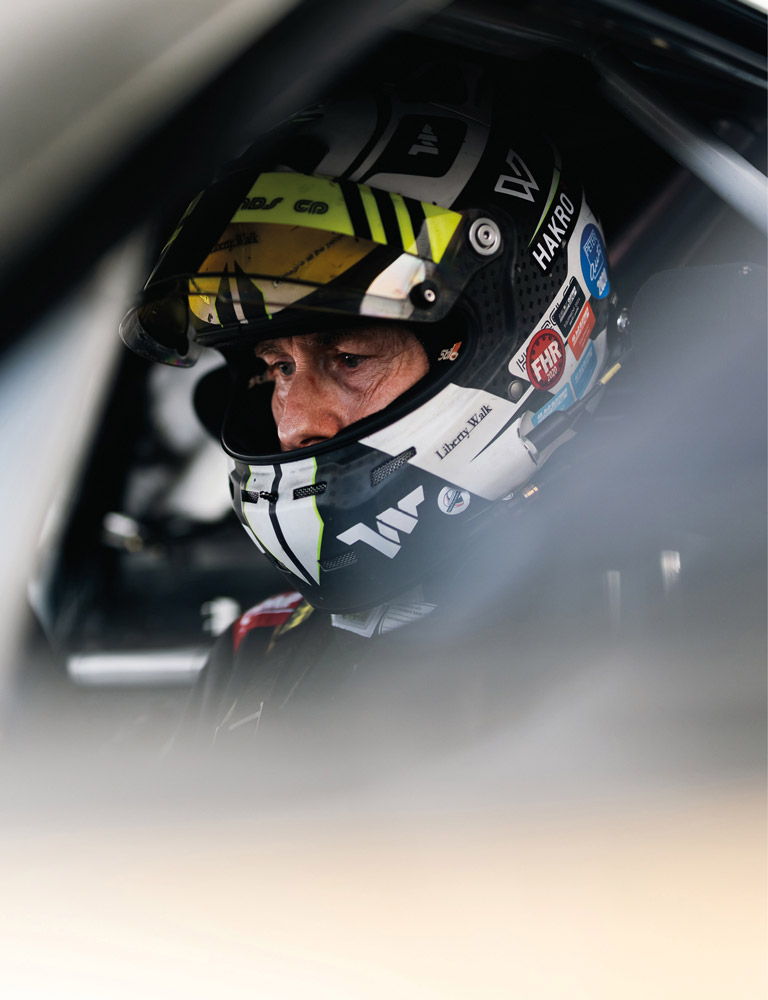
Prof. Wolfgang Henseler
DIGITAL TRANSFORMATION – Rethink, New Thinking, Forward Thinking.
Prof. Wolfgang Henseler is a leading expert
in creative technology, digital transformation,
and user-centric business models. As the founder of SENSORY-MINDS and a professor of Intermedia
Design, he combines scientific depth with
entrepreneurial relevance. With his unique mix of science, design, and strategy, he inspires
companies to connect technology with empathy.
Book Prof. Henseler for fresh
impulses at the intersection of creativity,
technology, and the entrepreneurial future.